|
Germany’s three-pillar banking sector.
Germany’s three-pillar banking sector comprises savings banks, co-operative banks and private banks.
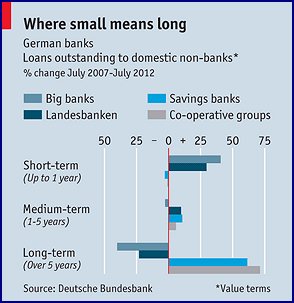
They argue that their business model is focused on working for the public or mutual good rather than for shareholders, and is well suited to the mixture of households and small-medium Mittelstand companies that they serve. That seems to be borne out by their lending record since 2007. Private banks reduced their medium- and long-term lending to companies and households between 2007 and 2012 in favour of short-term loans; the savings and co-operative banks increased theirs (see chart). It helps, of course, that Germany’s economy has been performing well.
The savings banks and co-operative banks provide about two-thirds of all lending to Mittelstand companies and 43% of lending to all companies and households. The Landesbanken, which act as wholesale banks for the savings banks, and DZ Bank and WGZ Bank, which do the same for the co-operative banks, step in to provide more sophisticated services, such as hedging and offshore financing.
The original, the “Big Brother” of public industrial banks, Frankfurt-based Kreditanstalt für Wiederaufbau, is now increasingly becoming the focus of similar, “public-good” oriented investment institutions.
Given the desperate need for growth in jobs, the bank-induced dearth of finance for working capital and investment offered to industry and infrastructure (if not the withdrawal of existing finance) – coupled with the traditional banks’ open abandonment of classical principles in favour of blatant and unrestrained gambling... the time must surely have come for a rethink of our banking landscape.
|